Saturday, March 30, 2019

Today Ginger got to go into the arena, along with her colt Ian, aka Bookbinder, and Reggie, the orphan from our wonderful show mare Born A Lopin Machine.  The story about Ginger has been told  and so many of you have followed her journey through her surgery.  She had her first shoeing since the surgery, one month ago.  She had her digital flexor tendon surgically severed to allow her coffin bone to rotate back to a proper angle.  Yesterday, our vet and farrier were at the barn together, along with one of our farm hands, Natalie, and I was there to watch.  Ginger's feet were x-rayed to make sure that the bones were in proper alignment and they were.  This was great news!  Ginger has been on 30 days of stall rest along with her colt Ian.  They have both been unbelievably tolerant and good about the confinement, but they were anxious to get out of the stall.  Before that could happen, Ginger had to be reshod.  Shoeing Ginger with this special shoe and wedge takes a long time, extraordinary skill and a lot of patience.  Our farrier, Clinton Smith, who is remarkable, was very patient with her and took almost two hours to do her feet.  The shoeing involves a special 10 degree wedge and shoe that has to be glued on around a special padding material.  The shoes are just glued on in the back, near the heel, and then a layer of glue is layered around the perimeter.  Ginger's toe is cut back to begin the process of reshaping her hoof capsule.  This is a complicated procedure.


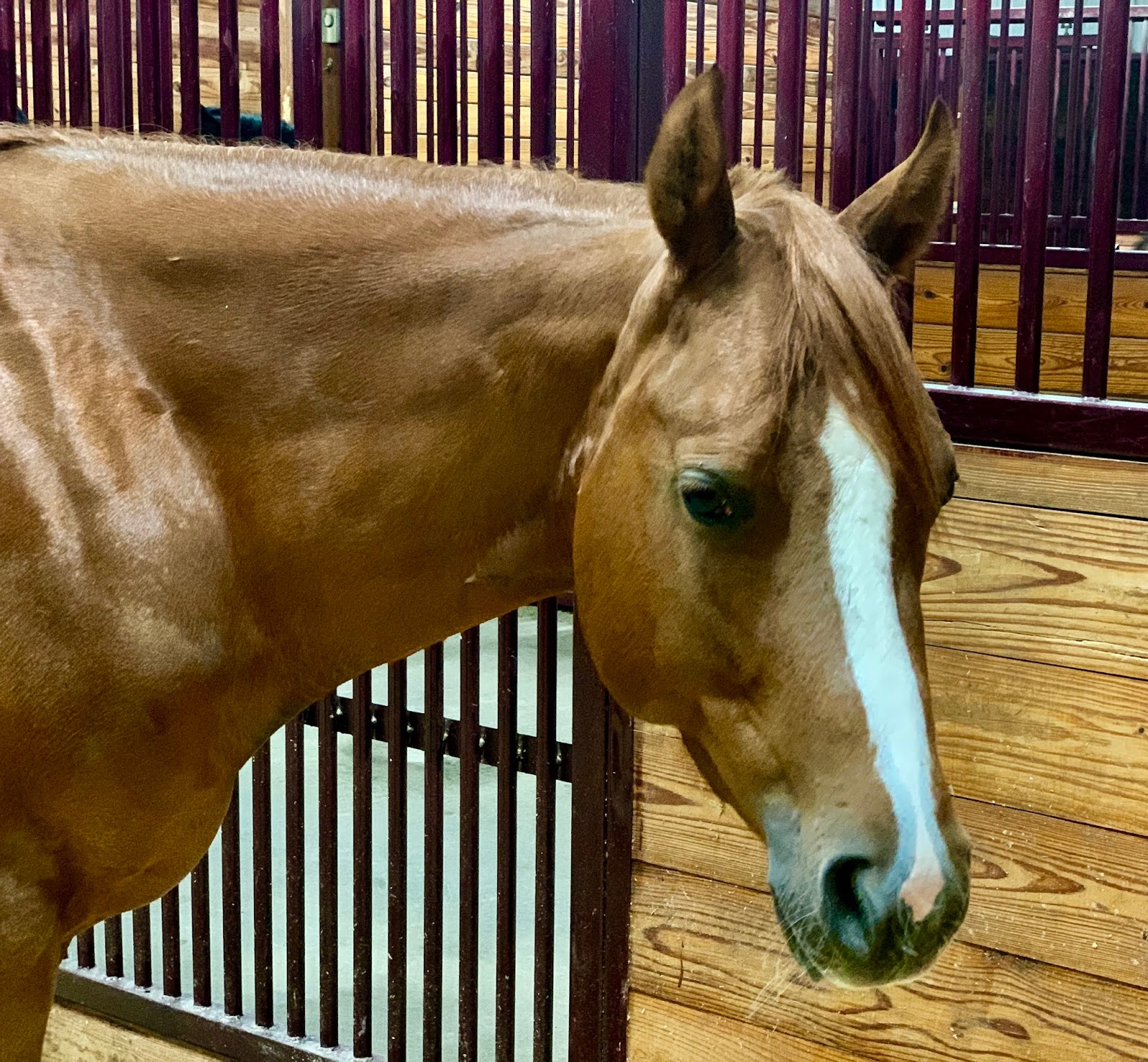
When the shoeing was completed, the foot had to be wrapped in a food wrap type of material to allow the glue to set.  After the glue had set up, we were able to handwalk her in the arena.  This allowed her and her foal to go out into the arena.  We took advantage of this to allow Ginger, her foal and Ian and Reggie to get to know one another.  Reggie is the orphan that is two months old.  The hope is that he and Ian will get to know one another, play and become horses together and maybe, Ginger will take him on as her own.  The photo at the top of this post gives us hope!  I've said this before, Ginger is very good minded, without any meanness in her bones.  She is kind and if anything, she has become even better minded throughout this ordeal.  There are quite a few months to go to say we are completely out of the woods but today was very heartwarming.

After I brought in Reggie to his stall, Natalie let Ginger roll, which she loves to do but hasn't been able to do for 30 days.

This was just icing on the cake!

Saturday, March 9, 2019

A quick update on Ginger and then a few words about Adrian, Reggie, Charlotte and Mae.

Ginger is recovering from her surgery, and will be for the next several months.  When she first returned home she was moving reasonably well, however after a couple of days, all of the pain relievers that were given to her during the surgery wore off.  She's been getting Equioxx, which helps a little, but she is now pretty sore.  This was expected.  Both the surgeon and the farrier warned of this and they said that we would notice some improvement after two to three weeks.  It has only been eight days since her surgery so we are managing through this.  Natalie changed her bandages on Saturday and on Monday, our vet will remove Ginger's stitches.  Two weeks after that, our farrier will be out to do her first post-surgical shoeing.  She is very good about the confinement, she is getting all the hay she wants and she gets grain, which I have begun supplementing with a calcium and phosphorous powder to meet the needs for peak lactation.  Her colt is now three weeks old and the peak period for milk production is around four weeks.  Making sure she has all the nutrients she needs can prevent some other problems so that is why I'm supplementing her.

That leads us to Adrian.  Born A Lopin Machine, aka. Adrian, was our best show horse.  She won futurities in 5 states, she won an NSBA Reserve World Championship, and a bunch of AQHA Highpoint awards.  She carried and delivered her colt by A Touch Of Sudden with no difficulty this year and she foaled out with little complication.  Four weeks after delivery she showed signs of colic, was rushed to an equine hospital.  The vet recommended and we approved emergency surgery.  I notified the insurance company, they wished us good luck and said to proceed.  Sadly, she did not survive the surgery.  She had a double torsion of her colon and too much of  her intestinal tract was damaged to save her.  The technical term of her condition is a "large colon volvulus".     The most common horse to develop this condition is an 8-10 year old mare 30-60 days after foaling.  Tragic as this was for us, we recovered and are now focusing on what we can do for her orphaned foal and what changes we can make in the future to try to prevent this from happening.  I have to say that without the guidance and care of our dear friends at BSB Quarterhorses, we would be lost.  I am in awe of how much they know and what they can do.  These are great horsewomen.  They did everything possible to save Adrian and they did save her foal Reggie by keeping him nourished and calm and adjusting to life without a dam at just five weeks of age.  In this month of honoring women, these are the women I would like to honor.  Their job is thankless, requires tireless work and dedication, with constant stress and not nearly enough compensation.  They even provided Reggie with a buddy, Johnny Deer.


Then there's Charlotte and Mae.  Charlotte, Certainly A Maiden, is our newest broodmare.  She delivered a beautiful filly by Lazy Loper on January 3rd.  Mae is her name and she is big and strong and was developing without a problem.  About a week ago, our other farm hand Tracy noticed she was coughing and acting lethargic, so I took her temperature and it was almost 104 degrees.  I immediately called the vet and she said get her to Michigan State ASAP because we had a case of rhodococcus last year and the symptoms presented were reflective of rhodococcus.  My wife and I got her and Charlotte in the trailer's box stall, which is essential for a breeding farm, and we headed off on the 100 mile drive to Michigan State.  It did not take long for the veterinarian staff to confirm the diagnosis of Rhodococcus.  Fortunately, Mae responded well to the treatment and after one week she was allowed to come home to our farm for further treatment.  She gets Rifampin and Azythromiacyn and she will be on them for up to three months.  However, her temperature is in the normal range and to look at her you wouldn't know she is sick.  She still coughs a little but nothing like she was.  This is a long haul but her prognosis is good.

This is what we've learned from this experience.  Take your foal's temperature regularly and be aware of any change to their behavior.  We did buy our own ultrasound machine to monitor changes in their lungs. We have learned to look for certain changes and if anything suspicious occurs we call our vet.  This is something the big thoroughbred farms in Kentucky do and we decided to do the same thing. 

It's been quite a week at Painted Plantation, one we won't soon forget.  Next time you think about breeding your mare, be ready for the unexpected!  Their lives and the lives of the babies depend on you and your ability to take care of them.  And sometimes, despite taking every precaution and following the best practices known, tragedies can happen and you've got to prepare yourself for that as well.

Friday, March 1, 2019

Yesterday, Ginger had her surgery.  The procedure on her left front leg involved severing her deep digital flexor tendon, which connects her coffin bone, (it's the pointed one on the bottom), to the muscle toward the top of her leg.  When she foundered, the laminae, which normally keeps the bone in the proper place,  gave way and the tension from the tendon pulled the bone back toward her heel.  This rotation caused the bone to point down, shown in the before photo on the right.  The procedure was done at Conley & Koontz Equine Veterinary Hospital outside of Ft. Wayne, Indiana by Dr. Ryan Rothenbuhler.

Ginger was sedated but not put to sleep.  Instead she was standing throughout the surgery.  Her lower leg was given a nerve block so she could not feel anything.  An incision was made on the outside of her leg, about three inches above her foot and extending up about four inches.  The doctor moves aside the exterior tendons to gain access to the deep digital tendon, which is about as thick as a human pinky finger.  He cuts the tendon to release the tension.   In Ginger's case, the tension was so significant that the gap between the severed tendon was about four inches.  This allowed the bone to rotate forward, which you can see in the after photo on the left.   

Ginger's incision was closed with five stitches and her leg was wrapped with sanitary wraps, then wrapped with gauze and finally wrapped with vet wrap to hold everything in place.  She was given a long lasting antibiotic to prevent infection.  She will get a second antibiotic injection on Monday, when our vet will replace the bandages and inspect the incision.

Now that was only half of the procedure.  The second half, which is done immediately after surgery, is to fit her with a special shoe, the profile of which you can see in the x-ray on the left.  The best way to describe it is a donut shoe with a wedge of about 6 degrees built into it.  It is put on so the angle goes up from front to back.  Her foot was packed with a cushioning compound, the heel was filed down significantly and the toe was pulled back then reshaped with epoxy.  After 4 to 6 shoeings the goal is to have a normal shape to the hoof and a normal placement of the coffin bone in her foot.  Our regular farrier attended the surgery and the shoeing so he could consult with the specialist shoer used by the clinic and he could also consult with the vet doing the surgery.

Ginger was given banamine for pain control on the trip home.  

During the entire procedure, Ginger's foal, Ian, who is two weeks old, was being held by our assistant Natalie, while I was holding Ginger.  The procedure, from beginning to end took about one hour and yet, he remained very patient and quiet.  The few times he got excited, a quick scratch on the withers or the dock of the tail and he quieted right back down.  I was very proud of him!

We left the farm at 11:15am, arrived at the clinic at 2:10pm, left the clinic at 4:30pm and got back home around 7:15pm.  Today, we expected Ginger to be sore but she was remarkably comfortable and moving well in her stall.  She is on stall rest for 30 days, to prevent the tendon from reconnecting.  Exercise would stimulate this growth so we do not want her to get much exercise.  This will be the biggest short term challenge because it means she will have the colt at her side constantly and he will need some excise and mental stimulation.  Can you say jolly ball, beach ball, lick toys, etc.!  

Today, he also got a second dose of plasma, just to make sure he is off to a good start and that he gets some protection from rhodococcus.  So our vet came out to the farm today and with Natalie's help, gave the foal his plasma, and checked on Ginger.  Our farrier was also at the farm and gave Ian his first trim, plus did the feet on the remaining horses.

If you ever go through this with your horses you can maybe learn from our experience.  You have to make a choice.  Ginger will never be ridden again but she can be made sound enough to have a full life.  That is what we are trying to do.  But it doesn't come cheap.  Those of you with horses can add up the costs and you'll know what all of this will amount to.  Less expensive options could have been tried and they may have worked and they may not have.  The value of the mare, from a purely business perspective, is another factor.  In Ginger's case, she's got that going for her because she's by Certain Potential and out of a mare by Invitation Only and out of Shesa Hot Cookie.  It is impossible to duplicate these bloodlines and they represent some of the best bloodlines in the quarter horse world.  The other thing is Ginger is a pleasant horse to be around, with normally good manners.  If you want to do your horse a big favor, teach it manners so that people will want to work with it.

As we move on with her recovery I'll post x-rays and pictures so you can follow along.

Monday, February 4, 2019

She always was pretty!

When Ginger was a baby I went to see her at BSB Quarterhorses in Sturgis, Michigan.  This is where she was foaled.  She was laying in this position for a nap while her mom, Hot Cookies Only, or Sugar as she is called, was taking a break to eat some hay.  I got down on the ground with my iPhone and I took this photo.  This photo ended up in the AQHA was selected by the AQHA museum as a fundraiser for the museum's expansion.  You will never see a more photogenic horse.  She was beautiful then and she is beautiful now, four years later.

She is a little better moving around.  The different medicine and the change in shoeing has made a difference.  She is now less than 3 weeks away from her due date and the foal has been moving around to get into position.  We are anxious to she what she has and to move on with her surgery.


Saturday, January 19, 2019


Ginger is actually doing a little better over the last couple of days.  Our farrier stopped by again on Friday to trim and shoe two other mares and while he was here he checked on her.  She still isn't putting her heel down as much as he'd like so we are going to keep checking each day and if she isn't doing that regularly in one week, he will come back and put an even larger wedge pad on that foot.  Today, I spent time with her in her stall and in the arena.  I noticed her relaxing that foot a little more than she has.  When I was hand walking her in the arena she actually jumped at the wind noise and then she just walked back to me like there was no problem.  That was the most encouraged I've been in a while.

The only other change we've made is to change her pain medication.  On a recommendation from our friends at BSB Quarterhorses, we asked our vet about switching to Equioxx, which is a different nsaid than we've been using.  It has less of an impact on her digestive system and it impacts different pain receptors.  They used it on a horse they cared for with a similar problem and it made it difference.  Our vet sent me a bottle and she's had it now for three days.  So far so good.  If you don't rely on the knowledge of others you will never get anywhere with horses.  No matter how much you know, how much you study, how much you read and do, there is always something to learn.  I've said it before that they are a great resource and they have more experience than I will ever have.  They are such great horse women and I truly appreciate their friendship.

So now we are about 1 month away from Ginger's delivery.  I anticipate more ups and downs but I can see the light at the end of the tunnel.

As for the picture, Ginger was being hand walked by Natalie and she layed down and rolled.  She stayed down for a minute to just rest and while she was down, her pasture buddy, Ernie Drives A Lexus, came over to check on her.  They really like each other and Ginger just let Victoria rub on her and groom her.  Some people like mares and some do not.  I love mares because at the soul, they care about their herd mates.  They are also capable of incredible tenderness.  I see it with the way they care for their babies and I see it when they care for each other.  Not a day goes by when I am not touched by their tenderness. 

Saturday, January 12, 2019

New shoes for Ginger

Today our farrier reshod Sugar Cookie.  He took notes, studied surgical videos and measured angles.  He used a different shoe, special pads, gel cushion and a special trim.  The nerve block she was given the other day did not make much difference.  She was still sore during the process but she got through it.  We noticed an improvement in her walk last night and this morning.  The hope is this will continue to provide her with some relief through the foaling process and afterwards.  Her due date is February 23rd.

Last night I went out to the barn and brushed her.  She is the definition of an "in your pocket" mare.  She just wants attention and a rub under her chin and along her throat latch.  When you do this she wraps her head around you and lays her muzzle on your outside shoulder.  She's more of a pet at this point than a brood mare.

We are supposed to only hand-walk her because her hoof wall on the bad foot is very fragile.  In fact, a portion the size of a quarter literally fell off during the shoeing process.  What is happening is the circulation in her foot has been compromised by the pulling on the coffin bone by the deep digital flexor tendon.  I am told and I have read that the laminae that connect the bone to the hoof wall are being pulled away and that is what is making the hoof wall fragile.  So I am going to try to walk her around the house and maybe around the neighborhood.  We did this years ago when "A Pretty Sensation" was recovering from her first colic surgery.  The neighbors are used to us doing this and often they will come out and pet the horse, take pictures and so on.

I wish I knew what caused all of these problems for Ginger.  I blame myself and I blame fate but really, there is no one to blame.  We've raised a lot of horses here at Painted Plantation and we have reached the point where we do a good job.  So as a breeder you just have to accept the fact that sometimes, there is nothing you can do.  Sometimes these things just happen.  You get over the disappointment and frustration by looking at the cute week old filly in the next stall.  You bring up old win photos of horses that you've bred and sold to others.  You look at the ribbons and trophies in the barn and the house.  You think about the people that you've supported and the work they've put in by helping to raise and care for the horses.

And then you move on.

Thursday, January 10, 2019

The next step

Ginger was given a nerve block in her left front leg today.  Our vet consulted with two other vets and between them they agreed on the medication and dosage to administer.  I can’t tell you how many times I marvel at the effort veterinarians put in to do best by our animals.  I also admire their courage.  They demonstrate it by admitting they want a second opinion.  I respect that because in my profession I do the same thing.  No professional knows everything.  It is instead the true professional that parks their ego and seeks the opinions of others and then thoughtfully comes to a conclusion.

I also spoke to our farrier, who is coming out tomorrow to reshoe her.  He also consulted with another farrier and they discussed past therapies and strategies and then they came up with a plan.  He had to drive to Ohio to get the necessary shoes for tomorrow.  Between the nerve block and a dose of bute in the morning she should be comfortable enough for the work on her feet.

In the meantime she is happy today and bickered for her food.   Onward and upward.

Tuesday, January 8, 2019

No Hoof No Horse

We had Ginger's front feet x-rayed today to compare them to the x-rays that were done in August 2018.  Before you see the x-rays let me give you a little history on her condition.

Ginger was two and was being prepped for sale at one of the national horse show sales.  She is a sweet mare, is remarkably beautiful and has very strong blood lines.  We thought she'd bring a high dollar at the sale.  Prior to the sale she started to show some signs of soreness on her left front foot.  A vet was called and recommended that we authorize check ligament surgery on her left front leg to increase the flex in that foot and to relieve some of the stress being caused to her coffin bone.  We took her out of the sale and we authorized the surgery.  After six months of time off and rehab, including time at a therapy center, she was doing better and we decided to put her in training to see what we had.  At first the training went well but Ginger kept developing abcesses in her left front hoof.  A vet was called to treat her and he recommended the usual treatment, time off, soaking, rest, etc. Eventually it became clear there was more going on in that foot.  X-rays were taken and it was determined the coffin bone was rotating downward.  We brought her home and began a program of therapeutic shoeing with our farrier.  This included pads with wedges, special shoes, leg rubbing with liniment to relieve the strain on the ligaments and tendons, and a few other things.  Eventually, she got to be reasonably sound and was able to resume just being a horse.  She was never going to be a rider but she could be a broodmare, she was only 4, she had so many positives including beauty, bloodlines, and kindness that we wanted to try to breed her.  Last year, we bred her to a double registered stallion named Iresistible Sudden by A Sudden Impulse.  He had produced several big winners and his bloodlines crossed well on her.

We were aware that the added weight of the pregnancy would have to be watched.  There would be a balancing act between giving her the necessary energy to allow the baby to develop but not make her fat.  To accomplish that, we've chosen just a ration balancer grain, with very low levels of starch and a good quality timothy, orchard grass and alfalfa hay.  Until the 9th month of her pregnancy, there were very few days that she was too sore to go out.  She always had a slight limp but she would run and play and some days she would act perfectly normal.

Beginning in the 9th month of her pregnancy she became increasingly sore.  The fetus was obviously growing rapidly and her belly began to get wider.  The added weight was enough to make her uncomfortable.  Plus, the hormones, the soreness from just carrying a baby and the lack of energy has made her less than happy.  She is still kind but just kind of grumpy.  Our vet has been out to look at her multiple times and so has our farrier.  It was suggested that we try bute and give her omperezole to reduce the risk of ulcers.  It was also suggested that we try Soft Ride boots to relieve some pain on the sole of her feet.  These therapies have helped but have not eliminated the problem.

The x-ray below is today's image of her left front foot.  The plan now is to adminsiter a temporary nerve block to get her through the delivery.  Our farrier and another farrier are consulting each other on additional shoeing techniques through the remainder of her pregnancy.  After she delivers, we will administer plasma to the foal to help build up the immune system and the foal's strength.  Soon thereafter, we will take them both to an equine surgeon in Indiana and they will operate on her deep digital flexor tendon, which should allow the coffin bone the ability to have less "pull" and possibly rotate back slightly, which would relieve her pain.  This surgery can be done with local anesthesia so that she won't have to be separated from her foal.  This is a long ordeal and it is nerve wracking but it is my responsibility.  I bred her mother to bring her into the world and she is my responsibility to care for.  This will be the only time she carries a baby.  If we breed her in the future, and that's a pretty big if at this point, we will do embryo transfers.

Like I always tell people, breeding and raising horses is not for the faint of heart.


Sunday, January 6, 2019

Caring for our injured mare Ginger during her pregnancy

Our mare Sugar Cookie, known as Ginger, is due to have a foal on February 23, 2019.  She also has a bad foot, her left front.  She has foundered on that foot, twice.  She's had surgery on her check ligament and on her flexor tendon but neither worked.  As she gets closer to delivering her foal, she gets more and more lame.  I am going to chronicle everything we do to keep her as comfortable as possible until she delivers the baby.

Friday our vet was out to check on our newest foal and we had her check out Ginger.  She had x-rayed her foot in August and used that information to provide guidance to our farrier.  After the examine, she said she wants to do another set of x-rays because she is worried the foot is worse than it was in August.  She'll be out tomorrow.  In the meantime, she and our farrier had a conversation about the foot and they will converse again after the x-rays.

Today we put on Soft Ride boots to help relieve some of the pain.  Ginger has also been getting 2 grams of bute a day for about a week.  I've also been giving her omeprazole to keep her stomach from becoming irritated.  Ginger hates getting these medications.  Watching a horse you love experience pain is hard.  Especially one that is as good natured as this horse is.  She is also at that point in her pregnancy where she is uncomfortable.

This is going to be a long seven weeks.

Friday, February 19, 2016

A Never Ending Commitment


A Never Ending Commitment 

1918
This was the year my two grandfathers sailed across the ocean from Malta, a very small European country, and landed at Ellis Island for immigration processing. Both men were 18 years old and recently married. Both of their brides who were only 16 had to stay in Malta. Neither of their families would allow them to travel to America until their husbands could support them.

Traveling was hard. They both stayed in small below deck quarters on small ships. It was a ten day trip in those days. It was hot, dirty, smelly and cramped. They were each sponsored for entry into the U.S. by family and friends. Back then you couldn't just cross the border and become a citizen. There were limits on the number of immigrants because the existing population wanted to protect their jobs and their way of life.
After they were processed my grandfathers lived with family and friends in New York before they both moved to Detroit seeking jobs in the auto factories. Neither man spoke much English. They had very few skills. They were willing and desperate for work as they sought to build lives for themselves. One got hired by Ford and the other by Chrysler. Their work was hard. They toiled every day in loud, dangerous and dirty factories. OSHA or union rights did not exist back then. There was no such thing as paid vacations, personal or sick days. These men of just eighteen years toiled and saved. They saved enough money to each buy a house. They bought homes in the Maltese neighborhood in Detroit, near the old Tigers Stadium.

After ten years and many letters and testimonials to their brides families they were able to bring their wives to America. I can't imagine how afraid my grandmothers were. They were leaving their families and friends and moving half way around the world to live in a country that they knew very little about. They were totally dependent on their husbands and they really barely knew them. After all they were married when they were just teenagers. My grandfathers didn't know what to expect either. They married girls and now they were women with lives that had evolved without them. Both families were reunited in 1928. The next year The Great Depression came.

The next ten years heaped unimaginable stress and anxiety on these two young couples. They struggled for whatever work was available. One shoveled coal to make up for lost work at the factory. One of my grandmothers cooked for my grandfathers factory foreman just so he would select my grandfather for whatever work was available. Being good Catholic families, each couple had children during this time. Their children were born at home at first. Doctors came after the fact.

It took more than a decade for the economy to improve. And then the whole world was at war.

These two couples were now just I their late thirties. I'm sure there were times when they fought and argued. They must have thought at times how awful their lot in life was. Each one must have wondered to themselves “is this all there is”. Yet they persevered. They sought the better life that they had dreamed of. They took joy in the growth and success of their children. They relished time with their families and the came to realize what they had built together would leave a legacy that was far greater than material success. Each family raised children that served in the military, that went to college, that raised successful families of their own.

I am proud of my grandparents and they are among my greatest heroes. When I see friends struggling with relationships I think of these four people and the dedication they had to one another.

Pam and I are celebrating our 39th wedding anniversary today and I will always be grateful for the role models they were for us.

Thursday, August 13, 2015

The Four Horsemen and The Red Rooster -- My Introduction To Texas

We had purchased a few horses from a breeder in Indiana and we had some success and a lot of fun.  They say that success makes you want more success and that was the case with us.  My trainer and I did a lot of research on the APHA horses that were winning and it became pretty clear that most of the horses that were winning the large national shows were coming from Texas.  They were bigger, stronger and better movers than the horses we were buying.   Or so it seemed.  I've since come to learn that great horses come from all over the country but I was still learning.

Anyway, we decided to go on a horse shopping trip to Texas.  My trainer had some connections with other trainers and he was able to make appointments for us to visit farms in Texas.  I was excited and looked at this trip as a guys weekend, similar to a golf weekend.  Recently, I had been to Pinehurst with 11 other friends and we had a spectacular long weekend.  We played great courses, ate good food, stayed up too late playing cards and drinking beer and we just got to relax.  This was my vision for this trip.

Our trip started out a little rough because our plane was late.  We left on a Thursday night, after I got done with work.  Our flight was supposed to leave at 6:30 pm and it didn't leave until almost 8:00 pm, which meant we wouldn't get to Dallas/Fort Worth airport until 9:30 pm Central time.  When we arrived at the airport, we went straight to the car rental counter where our car was waiting.  We hopped in and drove straight to our destination, The Four Horsemen Motel.

For those of you from the Pilot Point, Texas area, you'll know this motel.  Not being from there I wasn't sure what to expect.  My trainer, who made the arrangements, assured me that it was a good place and his friend, a farm manager that he had once worked for, was able to get us a good rate.  We pulled into the parking lot around 10:30 pm and stopped at the office.  We walked in to the somewhat disheveled office and there were two friendly ladies who were closing up for the night, literally.  I asked if they had our reservation and they said yes.  One of the ladies offered us each a cookie and since neither of us had eaten dinner, we gladly accepted.  I asked them what they would have done if we didn't get there by the time they left and closed the office.  One of the ladies said to me, "Sweetie, we would of just left the key under the mat outside with a note on the window."  Obviously we weren't in Detroit any more!  Back home this would have been a good way to get robbed.   Since I hadn't been called "Sweetie" in a long time, I was little disarmed and just nodded politely, took our keys, one for each of our separate rooms and walked to the door.  The other lady said the room with the bigger key is a suite and my trainer offered for me to take that room and he took the other.  We drove to the back of the hotel where our rooms were, it was pitch black outside so you couldn't see much with the dimly lit door lights being the only light to guide us.  We agree to clean up for a minute and then meet at the car in ten minutes to get something to eat.

I have traveled often in my life.  I have been in every state East of the Mississippi River and most of the states west.  I have stayed in some of the finest hotels and in some of the dumpiest.  Once I stayed at a place in New York City where I was greeted at the door to the hotel by a group of hookers asking if I had any drugs for sale.  That was kind of eye opening!  It wasn't like staying at the Plaza, which was a spectacular experience by the way.  Another time we traveled to Richmond, Virginia and the hotel had an alligator in the fountain in the lobby.  Well back to the Four Horseman.  I walked into the suite, which was very clean but obviously very old.  I was used to staring at cottage cheese ceilings, but never have I seen cottage cheese walls before.  And they were painted with what can only be described as operating room gloss white paint.  When I turned the lights on that room was so bright I think really think you could have seen well enough to do surgery!  The carpet was sort of a blue color and the bed spread with kind of a green and orange paisley.  I set my bag on the bed and it kind of bounced for a few minutes.  This was going to be interesting.  I unpacked my belonging and placed them in the drawers of the dresser that looked identical to the one I had in my bedroom growing up.  I knew my parents had given that bedroom set away when I went off to college so I never thought I'd see ever see it again.  Who knew!

I walked into the bathroom to wash up and the cottage cheese/bright white theme continued.  I looked in the mirror and could see every whisker on my face with a clarity that I'd never experienced before. I splashed some water on my face and turned to grab a towel when I realized there was one purple towel and one orange towel.  These towels were clean and you could still smell the bleach that they had been washed with.  Not only that but they were stiff as a board.  Seriously, I took one off the rack and it stayed folded and upright, as if to allow me to stand it up on two feet with the fold in the middle.  Again the bathroom was very clean so I thought to myself that its only for the weekend and I can make this work.  We aren't going to be in the room for very long anyway.  Plus its a suite so I can sit down for a few minutes in the other room and relax before we go and eat.

I go to the other room and there is a small sofa, which was very worn, facing a tv with a dial.  Even fifteen years ago, most television sets had abandoned dial tunings and were remotely controlled.  But even more interesting was this television had a rabbit ear antenna, which I hadn't seen since we were in college.  I turned it on and it took a minute for the tv to "warm up" and the picture to stabilize.  I cranked the dial around to see what channels were available, there were only two that came in so that made choosing less complicated.  I selected the channel that had a football game on and I went to sit on the sofa.  I went straight to the floor.  Picture me with my shoes on the floor, my knees bent so that my shins were pointed toward the ceiling and my rear end sitting on the floor with only the thinnest of cushions and the remnants of a spring between me and the floor.  It was pointless to call the front desk because the ladies that gave us a cookie and called me "Sweetie" had surely left by now.  I struggled to get up and just sat on the bed for a few minutes before going outside to wait for my trainer.  He soon came out and he said there probably isn't any place around here that's open other than the Red Rooster, which is on the same property.  Let's just go there and have a drink and relax and then we can get up early and have a big breakfast and start our search, he suggested.  I agreed since eating at 11:00 pm is never a good thing for me.

In we walk to the Red Rooster!  The Red Rooster is sort of a bar/honky tonk/meeting place all rolled up into one.  We sit at the bar and there are two, three foot tall plastic drink holders like you see with those blue drinks that people get in Vegas.  Instead of a blue concoction these were filled with goldfish crackers about half way up.  I noticed people would just grab the containers and pour our a handful and just eat them.  There was no silverware or napkins to be seen so I assumed this was all there was going to be to snack on.  The two ladies who were behind the bar were very busy.  The place was packed because it was Karaoke night.  More on that later!

After a minute one of the bar tenders approached.  She was probably as old as I was but she clearly had spent a lot of time in the sun because her face had that weathered look to it that you get from too much sun exposure.  She also had a cigarette dangling from her mouth with an ash that was at least one inch long.  Without taking the cigarette out of her mouth and without loosing the ash she said, "What do you want to drink Sweetie?"  Twice in one night, hmmm!  I asked what do you have?  She obviously knew at that moment that I was not a local and she told me in a somewhat, "What in the world is this guy doing here" sort of way that they had whiskey and beer.  Great I said.  What kind of beer?  Coors and Lonestar, she responded.  I'll have a Coors.  My trainer had a Lonestar.  Now he was more appropriately dressed because he had his hat and boots on so he fit in a little better than I did.  I tried to just sit there and drink my beer and just relax.

I said to my trainer that this place is really loud.  He said it's all concrete.  I hadn't noticed when we walked in but he was right.  The walls were concrete, the ceiling was concrete and the floors were concrete.  There wasn't a stitch of carpet anywhere in sight.  At the back of the building was the Karaoke stage and one person after the other took the microphone and attempted to impress the crowd.  I noticed the crowd was a mixture of just about every kind of person you could image.  As I look back on it I'm reminded of the Toby Keith song, "I Love This Bar," because this place had everyone of those characters.  There was a policeman who had gotten off work, there was an Indian wearing more turquoise jewelry than I had ever seen, there were cowboys and farm hands, there were girls looking for a date, some not looking for a date and some selling a date, if you know what I mean.  As I was halfway through my second bottle of Coors I noticed the biggest man in the place stand up and approach the microphone.  This man was at least 6' 5" tall and he had to weigh well over 300 pounds.  He was broad shouldered and had massive arms.  You could see his shoulders and arms clearly because he was not wearing a shirt.  Instead he was wearing green bib overalls and a John Deere ball cap.  The next few minutes were, to this day, some of the most surreal I have ever experienced.

I anticipated that this guy would attempt to sing a Waylon Jennings song or maybe a Merle Haggard tune.  On second thought, maybe he's going to sing something by George Jones.  The noise level in the place dropped a bit as people noticed he was moving to the stage.  He'd obviously been here before and people were paying attention so I thought this should be interesting.  The sound had been reverberating throughout the building all night and my ears could not really take another bad song sung by someone that couldn't hold a tune.  Karaoke can be bad but when the sound ricochets around a concrete building that echoes like he Grand Canyon no amount of beer is going to sooth that sound. So I was hopeful that this wouldn't be bad.  The music track started up and it sounded familiar but not at all what I was expecting.

John Travolta was popular in Texas because he had done Urban Cowboy and the movie had been a big hit a few years before.  I've been told that many of his movies became sort of cult classics in Texas after this movie came out.  Apparently, the guy in the green overalls was a fan of John Travolta's work in Saturday Night Fever and saw himself as Travolta's character Tony.  The soundtrack playing was that of the Bee Gees singing Staying Alive only without Barry Gibbs.  All I could think was this guy is never going to be able to sing those high notes to this soundtrack, this is going to be awful.  Let's just say I was shocked.  The guy could carry the tune and singing in what was obviously a falsetto voice, he managed to hit most of the notes and stayed reasonably close to the correct key.  As he sang, most of the girls with dates, paid for or not, and their guys were up on the dance floor.  I asked the off duty cop, who was now standing next to me at the bar, if this guy is a regular.  The cop said he's here every night and he has a regular following.  He also said he'll sing all kinds of songs and everybody seems to enjoy it.  The cop asked where I was from and what I was doing in the area.  I told him we were on a horse shopping trip and he said there were a lot of nice ranches nearby and we should find what we were looking for.  I asked the bar tender, who was now smoking a new cigarette, to bring the cop a beer and me the check.  I settled the tab and we left to go back to the room and get some sleep.

On this trip we went to fix or six ranches and we probably rode twenty or twenty five horses.  We couldn't agree on anything so we didn't buy anything that weekend.  I don't even remember what horses we rode or what ranches we went to, but to this day, I still remember the Four Horsemen Motel and the Red Rooster Honky Tonk like it was yesterday.  And so went my first real horse buying trip to Texas.

Saturday, June 13, 2015

Remembering To Have Fun


I'm going to skip ahead a few years.   By now we had turned things in the right direction.  We had some horses in some of the big national futurities, we had won a few events, we overcame some significant setbacks, and I was proud of what we had accomplished.

We created a business, the business we have today.  We worked very hard to make this work.  When we didn't have a horse business, I road 4 or 5 times a week.  Last year I only rode Sensational Sara, one of our broodmares,  twice and she wasn't happy about it!  She figured that after her fourth baby her riding career was over.  It's like any other small business.  You have to work hard to establish your business, and once established, you have to work twice as hard to keep it going.  However, every now and again I remember why we started this business and why I love being around horses and the people that work in the industry.

Today I'll tell you about the most fun I ever had at a horse show.    There was a point when we had two brood mares and two show horses.  One show horse was mostly the responsibility of my trainer.  Her name was One Sensational Diva; she was known as Bambi in our house.  She has had a wonderful career, and even though she is 9 or 10, she still shows today.  In fact, a young lady just won a Pinto Horse Association World Championship on her this past week.  The other show horse was Charlies My Daddy.   We called her Maria, and she was my horse but everyone loved her.  She is a broodmare now and is owned by a friend of ours that lives in Texas, but back then I rode her whenever I went to the barn.

Everytime I would go to a show to ride Maria I would learn something new.  I began at the lowest level of riding, Novice Amateur.  This meant I didn't have enough points, accumulated by placings in events, to qualify as an amateur.  I was happy about this because most amateurs are pretty good riders and at the beginning I was not.   We had been to the Tom Powers Triple Challenge Futurity the year before, and that was pretty eventful.  My trainer won the 3 year old Color Breed futurity against many very nice horses, on Bambi.    I tried showing her and she ran off at a gallop and I ended up watching the class from the center of the ring.  This was just a little embarrassing!  Then I showed Maria in a quarter horse class and we actually did well.  But, during the lineup I let Maria reach down and grab a mouthful of grass, got marked down, and we lost the class.  I loved that horse but looking back maybe I did spoil her a little!

So it's now Memorial Day weekend the following year.  Every Memorial Day there is a big Michigan Paint Horse Association event in Mason, Michigan.  Mason is the home of the Ingam County Fairgrounds and they have a very nice show facility.  There are ample stalls, there is a nice indoor show arena, and there were several very large outdoor practice arenas.  Going to this sight would give me plenty of places to practice, which I liked.  At this event, they also hosted a sweepstakes class for Open riders.  An Open rider is anyone good enough to compete at the highest level.  It could be a professional or a very good amateur.  Usually these events have the best horses and we wanted to enter Bambi in this event.  Mostly we wanted to know if her success the year before at the Tom Powers Futurity was a fluke or if she was really as good as we thought.

As I said, usually going to a horse show meant tagging along with four or five other amateurs, the trainer and his assistant and a half a dozen horses.  For this event it was just the trainer and me and Bambi and Maria.  We decided to practice as much as we could at home, drive up to Mason, about 2 hours away, on a Friday night.  We let the horses settle in and came back out to practice on Saturday then began showing in the afternoon.  So here we are, two guys going to a horse show, with the hope of competing and doing well.

We were not what you would call detail oriented.   It became pretty clear to us that we didn't really think this through.    The first night went easily enough.  We got up early the next morning, met for breakfast at the hotel restaurant, then we left for the show grounds.  We arrived around 7:30 am, fed the horses, cleaned their stalls, set up the tack stall and went to the office to register the horses for their classes.  I showed Maria first, in the early afternoon, and my trainer showed Bambi a few classes later.  So far so good.  We saddled up the horses in their work gear and we went out to practice.  Both horses rode well.  We didn't have to lunge either horse, you could just hop on their backs and walk around for a few minutes to warm them up and let them see the sights.  They were great!  Not many people knew us yet, a few recognized us from some advertisements we had run the year before, but most people didn't have a clue.  A couple of the other trainers came by and said hello to our trainer, who they recognized.  They didn't know who I was, and that was just fine with me.  Most people on the grounds were much younger than me, and were better riders than me, but I didn't mind.  I was going to compete anyway and I was pretty proud of our horses because I knew they looked good.

Here is when the fun started.  The practice arenas were a little dusty and it was a warm day so the horses worked up a sweat and had dust that stuck to their sweaty sides, so we had to bath them before we could show them.  So we take off their saddles and blankets and go to give them their baths.   We had shampoo, but for Maria, who had a very thick and long mane and just a beautiful and full tail, we needed a conditioner.  I remembered that on the advice of a horse friend, I had asked my wife to purchase a particular type of women's hair dye the next time she went to the salon because in the box with the dye came a very effective hair conditioner.   She told me she also purchased shampoo for Maria and put it in a tote bag that I put in the storage compartment in the truck.  I assumed she had gone to Tractor Supply or the local Feed and Grain store and purchased one of the usual horse shampoos.  I was wrong.  Pam purchased shampoo for Maria (Pam also spoiled Maria) at her beauty salon.  She also purchased a hair sheen product.  These were all made by Paul Mitchell.   So here I am at the horse washing area of this facility washing the mane and tail of my horse with fairly high end beauty salon products.  One lady asked if I always those products on my horses, but I knew she was thinking this guy is nuts!

We got both horses cleaned up, we covered them in coolers, which is a blanket you drape over your horse when it is wet to soak up the moisture, and we put them in their stalls.  After a little while we went back, took off the coolers and began to get them ready for the classes.  We had to band the horses manes so we attempted to do this ourselves.  We started with Bambi.  The purpose of banding a mane is to make the horse's mane look neat and trim and to accentuate the line of their neck.  When my trainer and I tried to do this we did the exact opposite.  No two hair bands were the same.  Picture the horizon of an uneven mountain range and that's kind of how our banding looked.  Realizing we needed help, we tracked down a lady in our show barn that was banding manes for $35.  So, we hired her to do our horses.  She did Bambi in a snap.  It looked great and neat and we were all set.  Now for Maria.

As I mentioned earlier, Maria had a long flowing mane.  We had decided to let it grow long the year before because it was beautiful.  However, it required an expert groomer to band her mane correctly.  Normally, my trainer's assistant did this chore.  To this day, I think she is the best horse groomer I've ever worked with.  The lady we hired at the horse show brushed Maria's hair.  She even mentioned how soft and manageable it was.  I told her what I used and she laughed!  She said she didn't feel she could band her mane properly and she suggested that we just comb it out and show her as she was.  That's what we did.

Not long after this, we had the horses saddled and we had to get our show outfits on.  I brought along four or five neatly pressed and starched show shirts, a half a dozen ties, two hats and two pairs of boots.  My trainer brought about 100 shirts - I kid you not - and at least that many ties.  After we picked out what we were going to wear we went to put on our chaps.  By now, my chaps, which were always a tight fit, were too tight to zip up.  Putting on chaps is always a little awkward but when you can't get the zipper up it's embarrassing.  My trainer pointed out that he was not about to help me with my chaps.  I was on my own!  Stalled next to us was a nice couple and I asked for help.  The guy said he couldn't help but his wife said she would help.  Thank goodness for kind souls.  She didn't comment on how tight the chaps were, which I appreciated, and she got them zipped up.

I showed first and it was the best ride I ever had on Maria.  We had two firsts and a fifth in a 20 horse class.  A little later Bambi showed and she finished second in the Junior Western Pleasure.  Man that was fun and I can't express how excited I was.  Between the two horses we accumulated almost 30 points in two classes.  The following day was the Michigan Sweepstakes, which was an event that had a decent jackpot but more importantly, some top trainers brought their horses to compete in the class.  This time Bambi won!  My trainer came out of the pen smiling and I was elated.  We had a national level show horse.  This was unbelievable!!!  Just for good measure, I showed Maria the next day and I got a second in a class of 15.  This was a great show. It was fun, I met a lot of people, and we were gone for less than 3 days.  I look back on that show when I get down.  I will never forget how happy I was on the ride home.


Thursday, June 11, 2015

Turning Things Around

If you've read my last few posts you know that my equine journey started out on some pretty rocky terrain.   I learned more than I ever thought there was to know and I experienced some glorious moments that would remain with me forever.   But there were all the problems.  It was such an emotional rollercoaster.  At this point it was either give up or turn this journey in a different direction.

To steal a line from the John Wayne move McClintock, I did some "thinkin' drinking," and I came to the conclusion that I had to try to get this right.  There was just too much upside.  My wife kept saying to me that if I really wanted to go on she was all for it.  In my mind I was already going to try, but the fact that she supported me was even better.

Up until know, I hadn't spent much on the actual horses.  I had spent a fortune on everything else, but not on the horses themselves.  The following point is important for everyone involved with horses to remember:  The Cost of The Horse Is The Cheap Part.  Repeat that to yourself several times and let it sink in.

Everyone hears stories like the California Chrome story of last year, where two everyday guys took one of their mares, that had very limited success, bred her to a bargain priced stallion and produced a multimillion dollar winner.  There were over 40,000 thoroughbreds born in the same year as California Chrome.  Your chances of having the same success are 0.0025%.  If you want to improve your odds of having a good horse, I believe you have to look for one who's bloodlines have the characteristics you desire.  You want one who's physical makeup, known as conformation, will stand up to the rigors of frequent riding.  Finally, you might want one that has a show record or has been ridden a lot so that you can learn from the horse.  This is what I set out to find for my next horse.

I wanted a Paint Horse.  I like many different breeds, but I really like Paints.  I already had a subscription to the American Paint Horse Association Journal and I had an online subscription to the APHA database.   The APHA Journal lists the top breeders, the top stallions, the top owners and many other pieces of data.  I decided to find the ten top breeders of performance horses and give them each a call.  I wanted to explain to them who I was and what I was looking for and see if they could help.  Some were cordial and were tolerant of my obvious "greenness," some were not cordial, and wanted to get me off the phone as quickly as possible.

After calling several other breeders I got around to calling Lynn Simons of Simons Show Horses.  If you're not a horse person you might not know who Lynn Simons was, and if you are in the horse world and you do know, please bear with me.  Lynn and his wife Andrea owned Simons Show Horses.  Their two daughters were leading youth amateur riders at the time.  Simons Show Horses owned then, and still own, Zippos Sensation.  Even back then, around 2002 or 2003, he was proving himself to be an extraordinary producer.   When I gave Lynn Simons my story and told him what I wanted to accomplish he began asking me a lot of questions.  Here's another life lesson, if you want to have an impact on people and connect with them, ask more and talk less.  Lynn had that skill.  By the end of the conversation he could of sold me the family dog, put a toy saddle on it and called it Secretariat.  I would of bought it.  That's not what happened.  Instead he told me he'd think about things and see if he had anything that would work for me; if he didn't he would send me to some other people that would have what I was looking for.  I said great and I told him I'd call him back next week.  At this point, the ball was in my court and I wasn't going to give it up by waiting for him to call me.  So a week later I called and again he was generous with his time.  He said he had several young prospects but they were not finished show horses and that they wouldn't be a good fit for me.  I asked him about the idea of buying several prospects, waiting for them to develop, and then pick one for me and sell the other two.  He thought I was getting ahead of myself, he explained the cost of doing that, the time it could take, and the risk that none of them would work out for what I wanted.  There are many great horse breeders that truly care about the successful placement of one of their horses with one of their customers.   At this point, he gave me the names of two trainers that had finished horses for sale and he said I should call them.

If you ask enough people in the horse world you will find out who can be counted on to put the needs of their clients first.  I was fortunate to find Lynn because at this point in my search because I had not asked anyone else for help.  He could have lead me astray but he did not.   In hindsight, I should have  taken the time after the loss of Liberty to get to know more people in the horse business.  I should have attended more shows.  Attendance at most breed shows is free.  Within a 250 mile radius of our house are many large or very large shows.  I could have attended many and just walked around.  When you watch the shows you can see which horses are best prepared.  You can see the trainers that take care of their clients.  You can walk through the stall areas and see which stalls are clean and neat.  Which horses simply look the part of a show horse.   Keep in mind that for trainers, they are working during a show.  If there is some down time, usually there are some breaks in the action, you can politely approach the trainers and ask them about their program.  This is a good way to learn if you are a good fit for the trainer and the trainer a good fit for you.

Another thing to remember about my dealings with Lynn Simons is that I never forgot his helpfulness.  When someone in any business extends you a courtesy, you will always remember them.  When it came time for me to expand my horse herd, the first place I called was Simons Show Horses.  Over the years, I've been a loyal client of theirs, buying some of the best horses I've ever owned from them.  There are many wonderful people in the horse business.  There are also some that aren't so wonderful.  If you take the time to learn, as I've suggested, you won't have to rely on dumb luck like I did to find someone that was willing to help.

Back to the horse journey.  At this point I'm already feeling like I'm making progress and the road is getting smoother.  Both trainers that I was referred to were nice people and they both had horses that would work for me.  The first trainer had a mare and a gelding that were show horses.  I had it in my head that I didn't want a mare, I wanted a gelding.  This gelding, however, had a minimal amount of white and I really wanted a horse that looked like a paint horse.  At this point I'm going to give you another phrase to repeat to yourself over and over, "Pretty Is As Pretty Does."  The horse I passed on went on to become a world champion and multiple futurity champion.  He might not have been the "prettiest" horse I'd ever seen, but he sure was a good horse.  I just couldn't see it.

I went to visit the next trainer and he had a barn full of horses for sale that were all proven, experienced show horses.  His approach was a little bit different in that he asked me my budget and then he asked me what I was looking for.  He said I'm going have you ride several horses so you can see what you get along with and what you feel comfortable on.  I thought this was sensible and I got to ride several horses, and I rode for most of the morning.  By the end of the first day I had picked out two that I liked and arranged to come back the next day and decide.  When I came back the two horses were in their stalls and I asked if i could get them ready myself.  This way I could see how they would be for me to get ready.  Both horses were great in the barn aisle.  They were polite, well mannered and obviously used to being handled.  They were both geldings and they each had reasonably long show records.  As I recall, they were both 6.  After a couple of rides I settled on one of the horses and we agreed on a price.  I read the purchase contract, this was the first of these I had seen.  I said I'd like a vet check done, which we arranged, and upon a thorough exam, which included a lot of x-rays of everything, I signed the contract, wrote the check and had him shipped home.

My new horse, his name was Woody, went to a new trainer that I had begun taking lessons with.  He was young but he was already winning.  He had several clients with very nice horses and they all spoke highly of him.  Also, he was close enough that I could drive to his facility and ride every day.  Although my horse turned out to be an average show horse performer, he was a perfect horse for me to learn with.  In the practice arena at the farm, he never acted mean or intolerant.  He was strong and healthy and he carried me around without any problem.  I learned proper techniques for improving his stride, for improving my posture and improving my ability to communicate with the horse.  We even let our very young grand children sit on his back in the barn and he was a perfect gentleman.  The funny thing is, when we sold him, he actually was in Horse & Rider magazine, twice, in a feature titled, Horses We'd Like To Own.

So remember when you are getting started there are a few key things to remember.  The cost of the horse is not as important as getting a good horse for your needs.  If you have to spend more to get what you need, take the time to save a little more money and then buy the right horse, it will be cheaper in the long run.  Take the time to learn as much as you can by attending shows, visiting barns, attending classes, and speaking to trainers and clients in programs that are doing what you want to be doing.  Seek out the advice of professionals in the equine industry.  As much as we've done and experienced I still seek out the advice of great equine professionals like our friends at Simons Show Horses, the Girls at BSB Quarter Horses, our trainers at Bauer Gooding Show Horses and Shane Dowdy Show Horses.  Our veterinarian has also been a great source of information, Countryside Animal Clinic in Wauseon, Ohio.  They have seen more than we will ever see and done more than we will do with horses.  Finally, remember don't fall in love with a horse just because it is pretty, and don't settle on a horse until you find what you want.  Until next time.

Friday, June 5, 2015

When The Stall Goes Empty


So the new horse, we'll call him Scout, was a hunt seater that did all around events.  We got along well enough and I rode him regularly.  On one ride, things were going well and I was getting the hang of the difference between the gentle lope of a western pleasure horse and the canter of a hunt seater.  My new western saddle was comfortable to ride in and I was enjoying the day.  We came around a corner - why does everything seem to happen when I am riding around a corner? -  and I felt the saddle slip underneath me.  The horse went left and my weight shifted right.  I grabbed for the mane but it was too late.  I fell off.  To make matters worse, the saddle had now shifted underneath Scout's belly.  It turned out that Scout had another event he could add to his repertoire, saddle bronc riding!  By the time he calmed down enough to let me cut the saddle off of him, he was a mess.  He had several small cuts around his legs, nothing serious, but they did draw blood.  He was lathered up in a heavy sweat, his eyes were as big as saucers, and his ears were laid flat back.  I could tell, at that very moment, our relationship had been compromised.

I hosed off Scout, checked him out thoroughly, tended to his cuts and scrapes, and all the while he laid his ears flat back.  He was trembling a little, but I tried my best to reassure him that I hadn't and wouldn't hurt him.  I put him in his stall, fed him and walked back to the arena to get the saddle.  Now I was mad!  Really mad!  I saw what caused the saddle to slip.  The off billet, that's the strap on the saddle that holds the cinch (Google it), had completely shredded.  It was made out of industrial nylon and the fabric just failed.  This was a product defect and either the horse or I could have been really hurt.  I threw the saddle in my car's trunk and drove straight to the tack shop.  I showed the salesperson the saddle and explained what happened and I told her I wanted all of the straps replaced with good leather.  She brought out the manager, who could tell I was angry, and he apologized and asked if I could leave the saddle overnight.  They would clean it and replace the straps at no cost.  I returned to the store the next day, hoping the manager was true to his word and he was.  The saddle had been cleaned, the nylon straps were replaced with leather straps, and he again apologized.  He also told me he called the saddle maker and told him of the problem.  The saddle maker said he quit using nylon because he had several customers have the same problem.  I wish the manager hadn't told me that because I immediately thought the saddle maker should have had a recall.  I kept picturing the sign in the barn that said if you or your horse get hurt or die, it's your fault, but in this case it wasn't my fault!

Now to get back to riding.  I wanted Scout to trust me so I went out to the barn for five or six more rides, but he never trusted me.  Every time we rode he danced and pranced.  He wanted me off his back.  I could sense the anxiety in him and as hard as I tried, it eventually passed on to me.

I spent a week away from the barn, thinking about everything that had happened.  I would dwell on the negatives of losing the first horse to an freak accident, having a replacement that was not my style of horse, and then having a riding accident that wasn't my fault or the horse's.  Quitting would have been easy at this point.  It hadn't worked out the way I thought it would.  Yet, I remembered how great the feeling was when it was going well - when the horse and I were dance partners and we moved fluidly around the arena.  There just isn't anything else like it.  Trainers ride 10-20 horses a day, every day, for years.  Riding is a job for them.   Some horses are mean and nasty, some are dull and listless, and others just aren't athletic at all.  But every now and again, trainers come across that horse that reminds them why they started riding.  They share the same feeling I had; it is a joy unlike all others.  There had to be a way to get that back.

Every Saturday afternoon, during the college football season, I would sit in the garage, where I had installed a tv and a space heater.  I'd open the garage door and set up some lawn chairs and turn on the Notre Dame football game.  My neighbor across the street owned a delicatessen and he'd come over with sandwiches and other neighbors would bring pop and beer.  I'd provide cigars and the garage transformed itself into the neighborhood sports bar.  This particular Saturday, as I'm telling my horse riding stories to my friends, one of them said to me that I should buy my own horse.  The only two things I could think of at this moment was he was absolutely correct and how am I going to break this to my wife!  The game ended, I don't remember if Notre Dame won (they probably did because Lou Holtz was the coach then and he always had winning teams), and I cleaned up.  Pam popped out to the garage and she said she heard us talking about me buying a horse and she was all for it.  Ok, let's go!

I researched horses; I researched trainers.  I found a horse; he was a 6 year old gelding on the other side of the state.  I was told he had some training and he was safe to ride, the price was right, and we agreed that my wife and I would drive out the next weekend to take a look.  In the meantime, I opened a copy of a local horse magazine and I called several trainers.  I also called Michigan State University and enrolled in an evening class on Equine Management.  I wasn't going to make the same mistakes I had made in the past.

We went out to see the horse and he was pretty, and kind, and he was ridden up to us by a ten year old girl.  He was a palomino paint horse with blue eyes.  His name was Liberty, and I was hooked.  The seller agreed to deliver the horse to any trainer in the state and I told her I'd like a vet check done before I buy him.  Over the next week I called a vet, who went out and examined the horse, took some x-rays of his legs, examined him for lameness, checked his feet with hoof testers and pronounced him sound.  I settled on a trainer who was in between our house and Lansing, which at the time this was about an hour's drive.  This way, I'd be able to check on the horse's progress while the trainer got him ready for me, and then I could go to class.  I agreed to give the trainer 90 days, which was about how long the semester lasted.  By the end of the semester he should be good to go and I would know much more than I did before the class started.

Everything was going well.  The class was a great learning experience.  Michigan State has a wonderful equine program.  They breed Arabians and Belgians.  They have a college equestrian team, a judging team, several nice barns, several arenas, a wonderful veterinarian school and some great instructors.  I couldn't wait to go to class every week.  The drive didn't matter; I soaked it all in. I would call the trainer to check on Liberty and she would give me updates.  Some were more positive than others, but she was hopeful.  Finally, the 90 days were up and I began riding.  I wanted to see how far along he had gotten.

The trainer tried to temper my enthusiasm and asked that I take a few lessons at a walk and a trot.  I reluctantly agreed.  She explained he didn't feel quite right at a lope and she wanted to have a vet check him out.  Of course, I said yes.  She had a vet come out and the vet called me and said I think your horse is sore in his hocks and I'd like to inject them to make him more comfortable.  This process is similar to a baseball player getting a cortisone shot to improve the joint mobility in a shoulder.  The injection is a often a combination of a steroid and hyaluronic acid.  The vet said he'd need a couple days of rest and then he could get back to work.

The trainer called and reported that the shots made him better but not perfect.  She wanted to bring out a chiropractor.  Yes, there are horse chiropractors.  I had learned about them in the evening class, but I had never seen one work on a horse and I was curious.  I asked to be present when the chiropractor came out and the trainer set the appointment.   The chiropractor examined the horse and said he had lesions along his back and his hips were drooping.  He said he could adjust the horse's back and hips, but it would take several sessions.  He also suggested acupuncture.  Now this was new. I hadn't seen or heard of this, but if it would make my horse more comfortable so I could get to enjoy him, I was game.  After six treatments, and a thousand dollars, the chiropractor said the treatments were completed.  The horse could get back to light work at a walk and a jog, eventually working up to a lope after two weeks.

The trainer would ride the horse three to four times a week and I would go out on the weekends and ride.  He felt a bit more comfortable, but still not quite right, but I was thinking he just needed to get back into shape.  At this point I've owned Liberty for almost six months and I've hardly gotten to ride.  One day the phone in my office at work rang and the trainer was on the line.  She never called my office so I knew something was wrong.  She told me that Liberty had begun tripping as she would walk him down the aisle.  I asked her to provide more details and she said he would start walking and he would fall to his knees.  After a second, he would get up and walk on.  Then he would trip again.  She said she had called the vet out and I said I'd drive out to meet them. About an hour and a half later we all met at the barn and the vet couldn't find anything immediately wrong, but she suspected several awful sounding diseases.  She suggested that we haul the horse to the Michigan State Large Animal Clinic the next day for a thorough exam and tests.

I took the day off work, met the trainer at the barn in the morning, and she hauled Liberty to the clinic.  I drove my car, thinking I'd be able to get to work in the afternoon.  The clinic is like a hospital for horses, with an operating room, diagnostic equipment, and everything that you'd expect a horse hospital to have.  We checked him in and after a short while a veterinarian came by to examine our horse.  The vet listened to us explain the symptoms and he asked us to take Liberty to see a vet that was visiting from Europe.  He was in the building next door, and that building had an arena where Liberty could be lunged so the vet could see him move.  We led the horse to the next building and walked in to meet the vet.  He was very pleasant and explained that he owned horses and he competes in dressage.  I always like to work with vets that own horses; I don't know if it helps but I feel a connection that I find comforting.  He had his assistant put the horse on a lunge line and had her lunge Liberty.  After no more than three minutes of lunging, Liberty looked like he had regressed to where he was constantly on the wrong lead and often had the front legs on one lead and the back on the other.  The vet said I'd like to examine him a little more and he put him in cross ties.  He felt the horses legs, back and neck.  He turned the horse's head from side to side and up and down.  Then he brought out a small tool that looked like the thing your doctor has to check the reflexes in your knees.  He tapped Liberty's sides and noticed a different response at different points.  Then he stopped and turned to me and asked if my horse had ever broken his neck.  I was stunned.  He had never broken his neck, that I knew.  I said I had a vet check done when I purchased him and there was no evidence of abuse or neglect, and my trainer said he had never been injured while he was in her care.  The vet said I think your horse has a neurological problem, it could be a small problem or a big problem, but the only way to know was to x-ray his neck.

My stomach was sick.  I couldn't stop petting the horse.  The vet had to ask me to step back or he'd have to put a lead vest on me so he could take the x-ray.  I made him give me a vest because I wasn't leaving my horse.  The x-ray revealed the problem.  The third vertebrae was almost twice as large as the other vertebras.  Liberty had wobbler syndrome.  The vet explained that he was partially paralyzed and in a lot of pain because the joint was pressing on his spinal chord.  He calmly and kindly explained that there was no treatment for this syndrome, at the stage that Liberty had, and his prognosis was bleak.  The vet said he would eventually become unable to stand or walk.  The vet asked to have another vet run an electronic test, similar to, but not exactly like, an electrocardiogram.  They wouldn't check the heart, but they would check his nerves for normal activity.  This would confirm the diagnosis.  I nodded my approval.  Within ten minutes there were ten veterinary students and another vet in the room.  They were attaching small aluminum foil looking attachments to the horse's side and hooked them by wires to an electronic machine with a screen.  On Liberty's right side, there was a normal sine wave pattern.  The second vet said that it was a good sign, but they needed to check the other side.  Repeating the procedure on the other side, there was no sine wave.  Instead, there were random light pulses that reminded me of a bad tv signal.  The vet said this meant his nerves weren't able to read the signals from his brain because of the pressure and likely damage to the spinal chord.  The diagnosis was confirmed and both vets explained that the disease was common in several breeds, including Paint Horses.  They said there were some surgeries that could be done to fuse the joints but in Liberty's case the damage to the spinal chord was too severe, he would never be "cured," and he would always be in pain.  They said the humane thing to do was to put the horse down.  In a state of shock, I signed some papers, donating his body to the school for research.  After many condolences from the vets and the students, they left the trainer and I alone with Liberty.  I did not want to talk, and she didn't know what to say, so I thanked her for everything and I said she could go.  I'd be alright.

How could this happen?  Did I do something wrong?  Did I let the horse down?  I hugged him and walked him down the aisle where an attendant was waiting.  I remember her asking me if I wanted his halter, and I said no.  As she walked him away I turned around to compose myself and all I saw was an empty stall.

Horses are a companion animal.  You become attached to them and they become attached to you.  They know their surroundings and they learn the routine of their everyday life with you.  When tragedy strikes, as it had for the second time for me, you have doubts about whether to go on with this pursuit.  In many cases, people and horses can be partners together for many years without any incidents.  There are no serious injuries or illnesses, there are unexpected phone calls, there are no disappointments.  What if that's not the case for you?  What if your horse gets hurt?  What if your horse becomes ill?  Are you prepared for the heartache, the feeling that you've let your companion down.  Are you prepared for the expense of treating an ill or injured horse?  You can buy insurance for some medical emergencies but usually not all.  Do you know what to look for so you can see that your horse is having a problem?  Can you see the horse's gait is not quite right?  Can you see the horse laying down more than normal or rolling more than normal?  Do you notice if he's eating less or drinking less water than normal?  Can you take his pulse and his temperature?  Do you know how to give him a shot?  Is your trailer ready at all times to rush the horse to the equine hospital?  This isn't the pleasant side of horse ownership, however, it is likely that if you own horses for a long enough period of time you will have to have answers to these questions.  Your horse relies on you.  Yes they weigh over 1,000 pounds and they can survive in the wild but your horse doesn't live in the wild.  Your horse relies on you for his care and feeding.  Your horse needs you to be a horseman or horsewoman.  If you find out that you don't want to deal with these challenges then find something else.  Buy a boat, golf, garden, swim, anything that doesn't require you to have another living being dependent upon your ability to be it's caretaker.   If, however, the desire to share your time with a horse won't leave you, then you will face these challenges as calmly and resolutely as you can.  You will be there for your horse, no matter how difficult the circumstance.  If you feel this way, then you are on your way to being a horseman or horsewoman.

Sunday, May 31, 2015

Sad Way To Learn Several Lessons


After almost 1 year of lessons I offered to lease Tonto's horse from the instructor.  By this time, he and I had come to an understanding.  He was tolerant of my mistakes and I would put up with his sometimes obstinate behavior.  When were at our best, I felt an exhilaration that was unlike anything else I had ever experienced.  I suppose this is the reason we ride horses.  When it feels like you are dancing, i.e. you ask your horse to move a certain way and the horse responds correctly, you realize you've just communicated with an animal that is bigger and stronger than you and yet is so graceful, it can carry you gently at all of the gaits with it's back lifted up and it's legs driving underneath you.  You want this feeling to last forever.

Well the instructor agreed to lease the horse to me for one year.  We shook on it and I paid in advance.   She went on vacation for a week.  During that time, the horse and I had several successful rides.  When she returned,  just before Thanksgiving,  the weather was turning colder.  We discussed moving the horse to an indoor arena for the winter so that I could ride throughout the winter and the instructor was agreeable.  I told her I would call her after the holiday and we would look for a farm to move him to.  The Friday after Thanksgiving turned out to be one of the most disturbing days I've ever experienced.

My wife and I were cleaning up our house from hosting Thanksgiving dinner and the phone rang.  It was the instructor and she was sobbing so hard on the phone that I could not understand anything she said so I asked her to compose herself.  For a moment she did and she told me that Tonto's horse had died in a freak accident in the pasture.  I was crushed...she began crying again and I said I'd call her back later.

Now I had heard how fragile horses actually were.  It is hard to imagine an animal weighing 1100 pounds and 20 times stronger than a man is fragile.  They pull wagons loaded with people, they run 35 or 40 miles an hour in races, they pull a plow through fields, yet a small misstep can cause bones to break, tendons to tear, or muscles to pull.  In my leased horse's case he fell, while running on some wet grass, while he was turned out in a pasture, and landed on his shoulder.  This caused him to break his scapula, which is a large, paddle shaped bone stretching from his shoulder to upper leg.  Amazingly, after breaking the bone, he limped into the barn and collapsed in the aisle.  The vet rushed out but she could not save him and he was humanely euthanized.

I had a hard time processing the loss.  For a month I did not want to talk or think about horses.  Making the connection I had and then having it suddenly end left an emptiness that I had never felt before.  When I would flip through the stacks of magazines in the basket next to my chair in the family room my emotions would oscillate from anger to sadness.  Eventually, I called the instructor to talk and she immediately said "I've got another horse for you, when can you begin riding?"  I was a little taken aback, how could she just up and get another horse.  Didn't she know how much I cared for the one that died.  Our handshake agreement was that I would lease Tonto's horse, not a different horse.

So I went to the farm to see the new horse and he seemed pretty enough, sound enough, and she relayed to me that he had a show record, (that means he had competed in events at shows throughout the state and he had won or at least placed high enough to distinguish himself).  Also, he was nine so he was likely to be very calm when I rode him.

I told her that I'd think about it and that I'd call her to let her know what I wanted to do.  Finally, I agreed to ride the new horse, beginning in the spring.  My day job was and is very busy during the winter months.  This time away from riding allowed me to keep up with my workload and to further distance myself from the loss of Tonto's horse, which I was still struggling with.  He was my first horse, even though I was in my middle 40's, he was still my first horse.

Finally the snow melts, which in Michigan can take until mid April, the tulips poked through the ground and I knew it was time to get back in the saddle.  I decided to get a new saddle since all this time I had been using one provided by the instructor.  It never fit me quite right and besides, I wanted to start completely fresh.  So I went to a local tack store and I bought a new work saddle.  It was dark tooled leather with a dark suede seat that held me in place much better than the all leather seat on the saddle I had been using.  I took it out to the barn and the instructor brought out the new horse for me to saddle up.  The saddling went smoothly, I could tell he'd been there and done that.  We walked out to the arena and I mounted up.  He was taller than the Tonto's horse.

As soon as I asked him to walk off I began to forget the sadness and I became excited about my new partner.   I noticed his stride was a little bit longer than I was used to.  I could feel the movement being a little different than the shorter saunter that Tonto's horse exhibited when he walked.  After a lap or so I felt comfortable and I asked him to trot.  At this point the instructor yelled out to me, "He's going to feel a little different."  Now what, I thought.  Well I found out.  His trot was bouncier than the gentle jog I was used to.  I also noticed that his trot covered a lot of ground.   I asked him to stop and then I asked the instructor why he felt that way.  She then told me he was a hunt seater.  "A Hunt Seater"!  Now I didn't know much but I had seen enough to see the hunt seat horses in magazines and on videos and I knew that wasn't what I wanted.  I also knew that if she thought I was going to ride in those funny pants, which I read in a magazine are called breeches, I would look absolutely ridiculous.  I am 5' 9" and I weigh over 200 pounds with gusts up to 230.  Fat boys don't look good in breeches.  Trust me.  Thoughts of disaster began to creep into my head.

The instructor walked up to the horse and I and explained that he can do the all around events, not just the hunt seat.  I had no idea what the all around events were.  I read the APHA Journal that night and found out they are everything that you can do in a show arena other than what I wanted to do.  Trail, for instance, is an all around class.  The trail class consists of obstacles that you have to navigate in a prearranged sequence without the horse touching or knocking down any of the obstacles.  The obstacles could be poles layed on the ground in a pattern, bridges that you have to walk over or fences that you have to open an close.  You have to complete this course using the various gaits as they have been prescribed by the person laying out the obstacles.

I have to keep this simple, I thought to myself, and I didn't want to get too far ahead of myself so I told her that I would just like to ride for a month or two on the new horse so that we can get connected.  I know she sensed my dismay and I think she was hoping I'd jump at the chance at doing something completely different but I just wanted to get back to what I already had.  I had doubts that would ever happen but I wanted to try, plus I had this new saddle.

I asked the instructor what do I do to make the trot more comfortable and she said you should "post".  A new term.  I had no idea what she meant.  I asked for an explanation and she actually said the following, "rise and fall with the leg against the wall".  A response came immediately to mind but my mother taught me never to speak those words to a lady so I simply asked her to explain in more detail.  After a little time I felt I understood.  What posting really means is to lift yourself up at your knees such that your seat is out of the saddle in cadence with the movement of the horses outside front leg.  As his leg goes up, you go up and as his leg goes down, you go down.  This was measurably more comfortable than the bouncing up and down I was doing before so I thought this was worth continuing.  All we did on this day was trot.  We trotted and trotted until my legs and knees felt like jello and I had to stop.  I think it was three laps.